
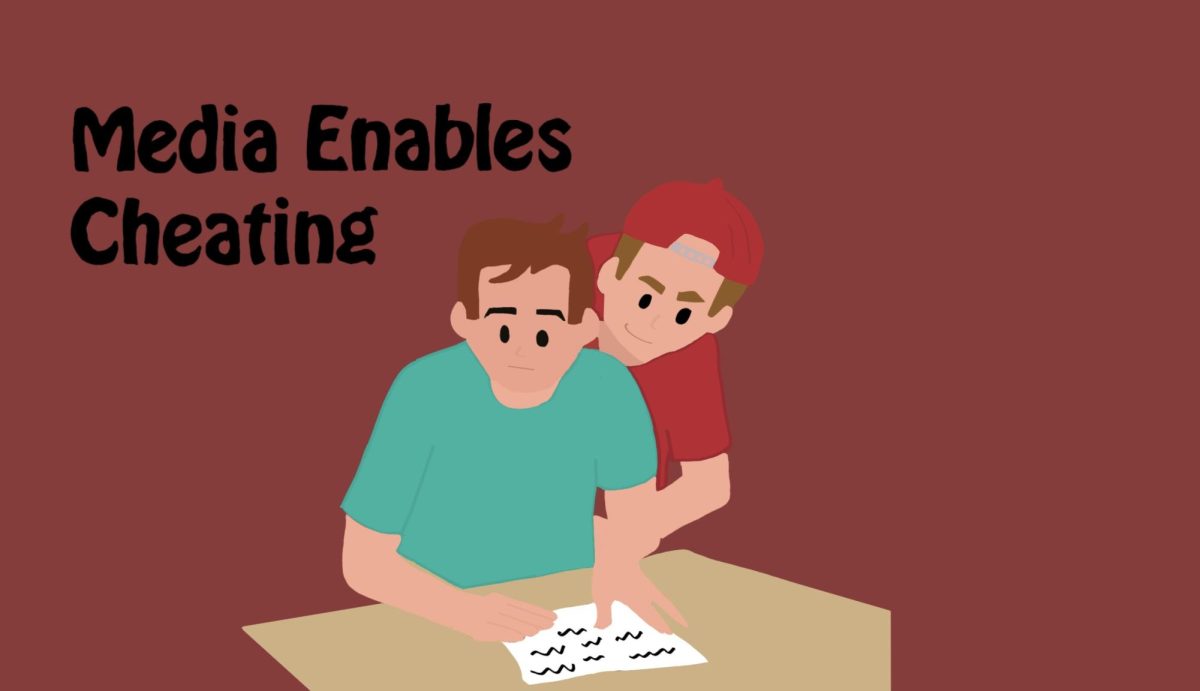
The media is well aware that audiences are drawn to immoral topics. Drugs, violence and cheating are all ugly topics, but undeniably hold power over the attentions of many viewers. Romance in film and television commonly includes cheating because it performs well: audiences are entertained by plotlines with infidelity. Despite its scandalousness, cheating entertains audiences, so it is written into much of popular television and film. Viewers do not deny the evils behind this topic, but choose to move past it for the sake of entertainment; however, it is important to acknowledge that the pervasiveness of infidelity in the media has detrimental effects on society.
The brain programs human behavior through patterns called “scripts,” much like a computer. According to a study by L. Rowell Huesmann, research suggests that humans search their scripts for a course of action in social situations. Approximately one-third of television programs contain depictions of infidelity in one way, shape or form as stated in research by Cassandra Alexopoulos and Hilary Gamble. Thus, chances are that the average viewer will frequently come across cheating on television. Based on research by R.S. Wyer, T.K. Srull and A. Brandura, repeated exposure will apply itself to a person’s script and therefore manifest itself in a person’s behavior. In addition, the person on television doing the cheating tends to be the main character as mentioned in research by Cassandra Alexopoulos and Hilary Gamble. Viewers are naturally inclined to identify with or develop relationships with the main character of any work of art because they spend most of the work learning about that character. Therefore, viewers are likely to support the beliefs and behavior of a main character. When asked about television, many Walpole High School (WHS) students reported that their favorites included cheating.
“I almost wanted [the affair] to happen,” WHS junior Ben Mortali said.
Often, cheating is written into visual media for shock value. An engaging show requires creativity, but more writers rely on one common cliché to captivate audiences: creating drama through infidelity. When writers use cheating superficially, there is no lasting impact within the narrative.
“When shows do that, they are taking the easy way out and neglecting how cheating can really affect someone,” WHS junior Ellie Boland said.
In “The Great Gatsby,” two characters, Tom Buchanan and Daisy Buchanan, are married; both are cheating on each other with Myrtle Wilson and Gatsby, respectively. When their affairs are revealed, they must flee New York to save their social status. Ultimately, Wilson and Gatsby both die violently and the Buchanan Family leave the city to escape their social ruin. “The Great Gatsby” is a righteous display of infidelity because the wrongful relationships end and the wrongdoers face direct consequences.
In “Moonstruck,” a woman named Loretta Castorini is engaged to a man named Johnny Cammareri when she starts seeing his younger brother, Ronny Cammareri. The movie chronicles Castorini and Ronny Cammareri’s thrilling affair and ends with their engagement. “Moonstruck” is a harmful depiction of cheating because Castorini’s relationship outside of her engagement is given a consequence-free happy ending. By sparing the characters from shame, “Moonstruck” relays the message that cheating leads to true love and happiness and omits the effects of Castorini’s actions on the people around her, even using the affair as a device for humor, since the movie is a comedy. A meaningful portrayal of infidelity comes with time spent repenting. Betraying one’s partner comes with consequences: people should display shame after cheating. Their favorite characters should reinforce that indignity. Some portrayals rightfully give karma to the perpetrator; examples include the aforementioned “Great Gatsby” and 1945’s “Brief Encounter.” However, a lot of other pieces of media, like “Moonstruck,” do not, such as “The Summer I Turned Pretty” and 2025’s “Marty Supreme.”
In shows with teenage audiences such as “The Summer I Turned Pretty,” cheating is used to hurt a character so the cheater can apologize and be forgiven. In most shows with the same demographic as “The Summer I Turned Pretty,” the show immediately moves on to the next story arc without elaboration. For instance, in “The Summer I Turned Pretty,” one of the love interests proposes to the main character to apologize for cheating and the main character agrees. Even though no act of remorse or shame was taken, when the main character forgives her fiancee, the audience does too.
Teenagers learn behaviors and social norms from screens. By moving on so fast from these offenses, the media unintentionally teaches audiences that cheating is not as rare or serious as it is. While the media does not have a moral responsibility to depict the “right” thing, young audiences lack the ability to criticize onscreen infidelity instead of glorifying it. Instead, the media should make it clear whether their work endorses or critiques immoral topics such as cheating by omitting or rewarding characters’ growth from their mistakes, respectively.
People are taught that cheating is acceptable and natural by their favorite shows and movies. While obvious to some, many people interpret what they see on-screen as the typical experience. Infidelity is widespread in film and TV; the media ignoring the consequences of cheating augments negative effects on an audience.
Modern TV and film beg the question: is media obligated to show unfaithful characters face the consequences of their disloyalty? Many teenagers’ only exposure to relationships is through television. When cheating is ubiquitous in movies and TV, it affects what young viewers expect from their own lives. People come to believe that cheating is bound to happen.