
The Olympics have been considered a staple of worldwide culture for over a century. Every four years, they take place as a way for people to celebrate the best athletes that their nation has to offer. However, in recent years, the Olympics, as well as the athletes who take part in it, have been criticized for making the games too political. This controversy reached a breaking point during the 2026 Winter Olympics in which featured many examples of the great performances of athletes being overlooked due to their political opinions and others even being banned for being too political in the eyes of the International Olympic Committee’s (IOC) eyes. Despite what many say, this is not a new trend. Since its inception in 1896, the Olympics have always been an overtly political event and athletes should not be criticized simply for continuing this tradition.
Throughout the 19th century, the newly independent nation of Greece repeatedly attempted to revive the Olympic games. Each effort was done with the intent of promoting nationalistic sentiment among the Greek people. Each of these revival attempts failed until 1896 where it was planned by French educator Pierre de Coubertin. Forty years later, the Adolf Hitler led Nazi Germany hosted the 1936 Summer Olympics. Due to the Nazi party’s reputation of extreme antisemitism, many athletes boycotted the games. These competitors doing so proves their recognition of the political implication surrounding the Olympics and the unimportance of sports when compared to human rights. Following World War II, the Olympics took on a new, even more political role, serving as a stage for the United States and Soviet Union to compete against each other in an extension of the Cold War. Both countries spent millions of dollars on their athletics programs, trying to assert social, political and economic dominance. By doing so, these nations solidified the political influence of the Olympics as they battled for world supremacy on the athletic stage.
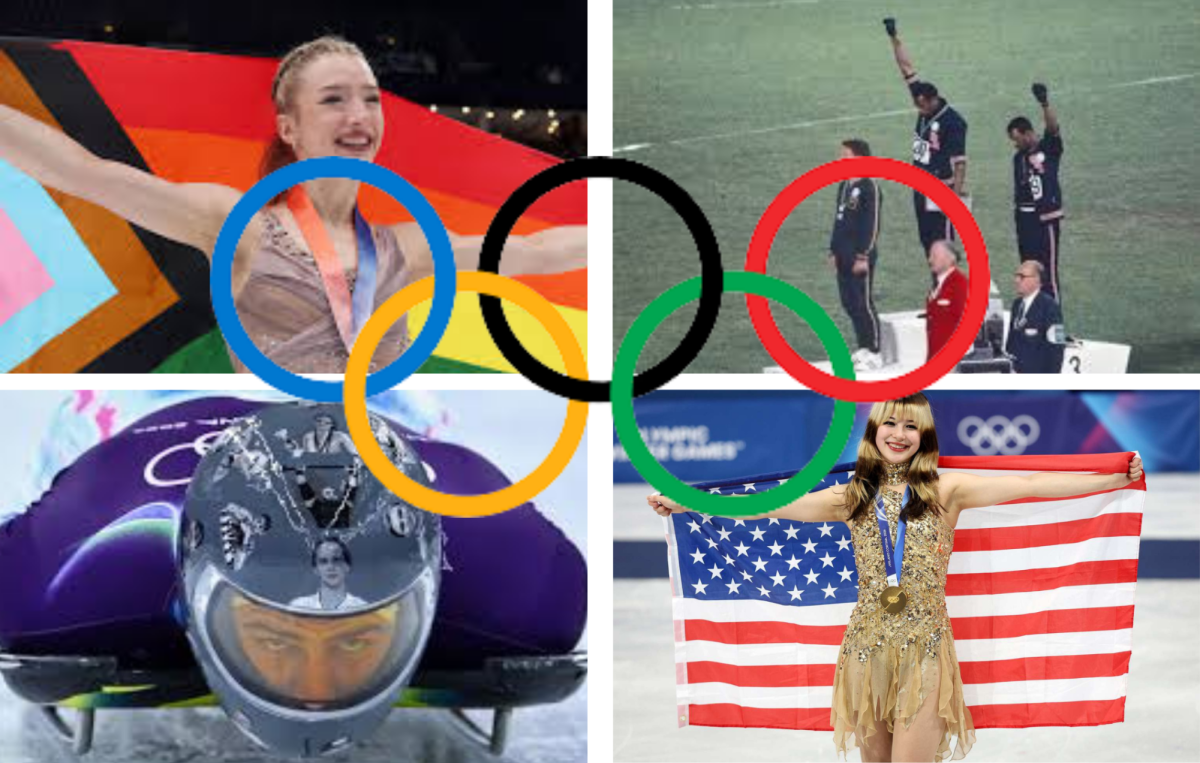
Not just nations, but individual Olympians also have historically been public about their political beliefs. In 1968, 200 meter gold and bronze medalists, Tommie Smith and John Carlos, raised their fists in a black power salute while standing on the podium. Smith and Carlos, along with silver medalist Peter Norman, all wore human rights badges on their chests, making for one of the most overtly political moments of the modern Olympics. Just like contemporary examples of activism, the actions of Smith, Carlos and Norman were harshly criticized at the time. They were condemned for inserting politics into the event, mirroring modern critiques of athletes. Despite the polarizing reactions at the time, modern audiences largely remember this as an important, positive moment in the American civil rights movement, highlighting that political activism has had a history of success at the Olympics.
One of the most celebrated athletes of the 2026 Olympic Games was American figure skater and gold medalist Alysa Liu. Liu has been applauded for both her abilities on the rink as well as her willingness to put aside her political opinions during the games. Although there is no issue applauding her for choosing to not openly express her political beliefs, problems arise when Liu is compared to her fellow countrywoman and figureskater, Amber Glenn. Glenn, unlike Liu, was quite vocal politically throughout the games, taking no issue with criticizing the current American presidency. Glenn, the first openly queer figure skater to compete for the American Olympic team, has been heavily condemned for her statements in support of the LGBTQ+ community and her criticism of President Donald Trump. Because of this controversy, Glenn’s performance has largely been ignored despite the fact that she finished fifth overall as the oldest woman to qualify for Olympic figure skating since 1928.
Ukrainian skeleton racer, Vladyslav Heraskevych, received an even harsher treatment than Glenn. In the lead up to the games, Heraskevych was informed that he would not be allowed to wear the helmet he had originally intended to: one featuring the pictures of Ukrainian soldiers who perished during the ongoing Russo-Ukrainian war. Heraskevych refused to wear a different helmet, reasoning that the lives of his compatriots were more valuable than a gold medal. This resulted in his disqualification from the games. Heraskevych’s removal came as a shock; the IOC has been markedly in support of the Ukrainian cause in recent years, even banning Russia from their gains due to their offensive. This shift in IOC policy reflects a broader, international movement towards avoidance of any topic that may be considered too controversial. By not allowing Heraskevych to support his fallen comrades, the IOC contributes to this trend and allows global powers to prey on weaker countries without the publicity that their atrocities deserve.
Political activism has always existed in the Olympics and has always been criticized when it first occurs. Going forward, it is important that society moves away from this mindset and begins to embrace activism at the Olympics. These acts of protest have often led to positive social change in the past, and so should not be discouraged in the present.