
From Shirley Chisholm’s groundbreaking campaign for president in 1972, to Kamala Harris’s historic election as Vice President in 2020, women in American politics have challenged government barriers that once seemed unachievable. Despite these achievements, female candidates continue to face a political environment shaped by gender expectations and criticism that their male candidates rarely endure.
Although women have made historic progress in presidential politics from the 1970s to today, misogyny has consistently limited their electability by shaping media narratives, enforcing double standards and fueling personal attacks, forcing candidates like Chisholm and Harris to meet higher expectations and endure an increased level of pressure imposed on women.
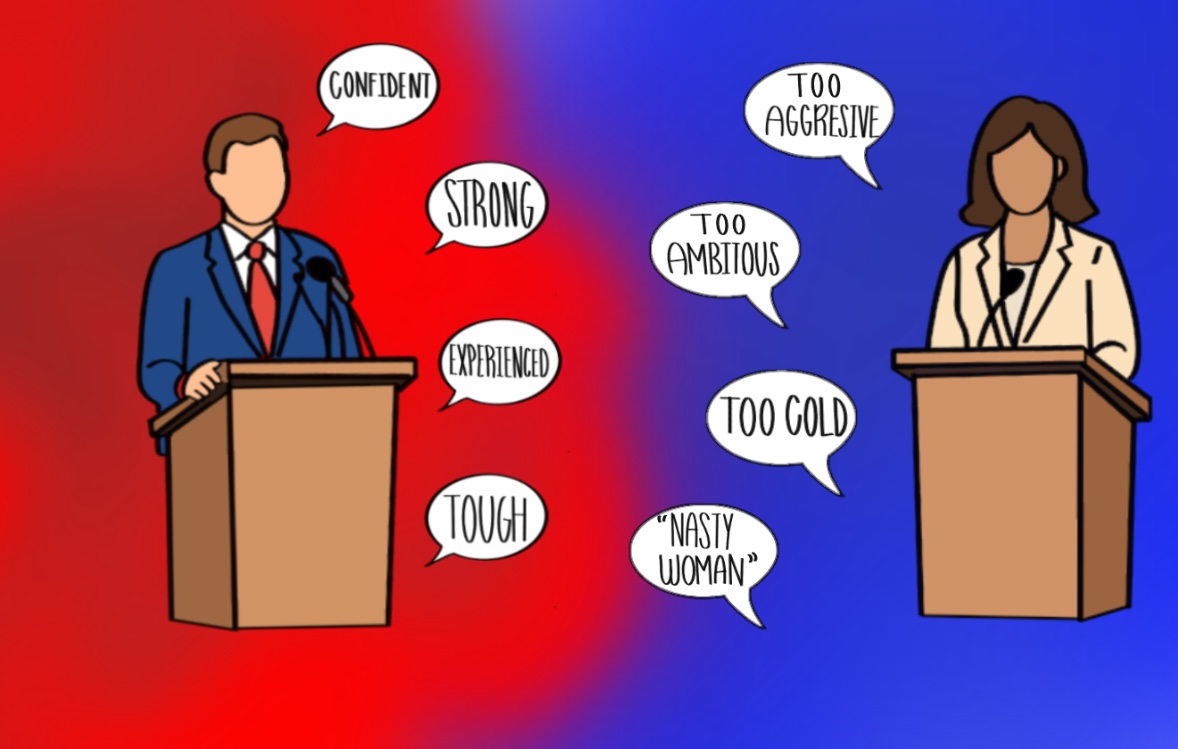
Media coverage and political messages in speech often portray female candidates through a gendered lens that emphasize personality, tone and appearance more than policy and leadership ability. This pattern became particularly visible during the 2016 presidential campaign when Republican candidate, Donad Trump, referred to Democratic nominee, Hillary Clinton, with derogatory terms during a televised presidential debate.
As a male opponent directly competing against Clinton for president, Trump’s comment reflected a dismissive attitude towards women challenging male authority. The insult quickly spread through social media and other news outlets, where “Yale Daily News” refers to the moment as one of the most memorable of the campaign. Rather than focusing on Clinton’s policy arguments during the debate, the phrase shifted attention to her personality and demeanor.
Oftentimes, misogyny functions as a system that punishes women who step outside traditional gender expectations, especially when seeking power or authority. In this case, Clinton’s assertiveness in the debate, something that is typically expected from presidential candidates, was reframed as inappropriate behavior for a woman. Modern journalism has also recognized this pattern.
A 2016 PBS article, “The hidden sexism that could sway the election,” notes that female candidates are frequently described as “cold,” “overly emotional” or “unlinkable,” while male candidates are rarely evaluated in the same way. These types of descriptions influence how voters interpret female leadership by framing women as personality figures rather than political leaders. As a result, media portrayals contribute to the persistence of misogyny in presidential politics by reinforcing stereotypes that make it more difficult for women to be judged solely on their qualifications and policies.
Female candidates in presidential politics must often meet higher and sometimes opposing expectations than their male competitors. Women are expected to demonstrate strength and proficiency while also maintaining a level of likeability that male candidates rarely are required to balance.
This double standard was blatantly clear when Democratic politician, Geraldine Ferraro became the first woman nominated for a major political party as Vice President. During the 1984 Vice Presidential debate, Ferraro directly confronted criticism about her qualifications after Vice President George H. W. Bush questioned her experience in foreign policy.
“I almost resent, Vice President Bush, your patronizing attitude that you have to teach me about foreign policy,” Ferraro said.
Ferraro’s response highlighted the frustration many female candidates experience when their abilities are questioned more harshly than those of male candidates. Because she was the first woman to be nominated for this position, Ferraro had to prove that she possessed the knowledge and leadership skills expected of a national political leader.
Throughout history, women have often been excluded from political authority positions and when they do attempt to enter these spaces, they are often seen as outsiders. This historical pattern helps explain why female politicians are frequently judged more harshly when demonstrating traits that are considered “normal” for male leaders. As a result, women in presidential politics must carefully navigate between appearing strong enough to lead and likable enough to satisfy public expectations. This double standard reinforces the barriers built off misogyny and continues to shape the way female candidates are evaluated by both the media and the public.
Furthermore, female candidates for presidential office are often targeted with personal attacks that focus on their identity, character or family life, rather than their political ideology or policies. This pattern can be seen as early as the 1972 presidential campaign of Chisholm — the first black woman to seek the democratic nomination for president.
In her campaign speech, “Unbought & Unbiased,” Chisholm openly acknowledged the discrimination she faced while running for office, explaining that she encountered more obstacles due to her identity as a woman than because of her race. As a groundbreaking candidate challenging both racial and gender barriers, Chisholm understood that many critics dismissed her nomination based on her identity rather than evaluating her political platform. Her statement highlights the reality that female candidates often face criticism rooted in stereotypes about gender instead of legitimate policy campaigns.
A 2024 study by the London School of Economics examining sexist attacks in the U.S. elections found that female candidates are frequently targeted with attacks about personality, morality or emotional stability, while male candidates are often criticized for their political positions or leadership decisions.
Gender discrimination has long been embedded within American political and legal systems, shaping cultural attitudes toward women in positions of power. These historical and modern examples demonstrate that misogyny in presidential politics frequently appears through personal attacks designed to question women’s credibility as leaders. Consequently, these attacks create additional barriers for female candidates and reinforce the idea that women must overcome greater scrutiny when seeking higher political offices in the U.S..
The election of Vice President Harris in 2020 was widely recognized as a historic milestone, marking the first time in American history that a woman, Black and South Asian individual, held a vice presidential position in office. This moment carried significant weight, representing what many viewed as a turning point in American politics and a sign of increasing representation at the highest levels of governments.
In her inauguration speech, Harris herself emphasized this idea of progress, acknowledging the generations of women before her who made her achievement possible. However, while her election indelibly reflects progress, it does not mean that true equality has been achieved. In fact, the public and media response to Harris reveals how deeply rooted biases still shape political conversations.
A 2020 report from Northeastern University found that media coverage of Harris has been unreasonably influenced by racism and sexism, often focusing more on her identity, tone or demeanor than her policies or qualifications. This kind of criticism highlights a double standard that female politicians, especially women of color, continue to face.
Unlike many of her male counterparts, Harris is frequently judged not only on her performance but also on how well she conforms to societal expectations of gender and race. This backlash complicates the narrative that her success alone signals equality, instead it shows that while barriers are being broken, they have not yet disappeared.
Harris’s position is both a symbol of how far the U.S. has come and a reminder of how far it still has to go. Her experience reflects that having more representation is a significant step in the right direction, but it is not enough on its own. As long as deeper biases still shape how women are viewed and treated, real equity in politics has not fully been reached.
Although women have made undeniable progress in presidential politics, the persistence of misogyny continues to reform both how they are portrayed and how voters respond to them. Media narratives that focus on personality over policy, double standards that force women to balance strength with likeability and personal attacks that question their legitimacy all reinforce the same barrier: women are still not evaluated on equal terms as men.
Even as more women run for and win highly ranked offices, these biases continue to influence elections and shape public perceptions, limiting how far progress can go. If presidential politics is to be set up in a system that truly reflects equality, these patterns must be actively recognized and challenged. Only then can female candidates be judged primarily on their qualifications, ideology and leadership abilities, rather than outdated expectations about gender that have dominated presidential political elections for decades.