
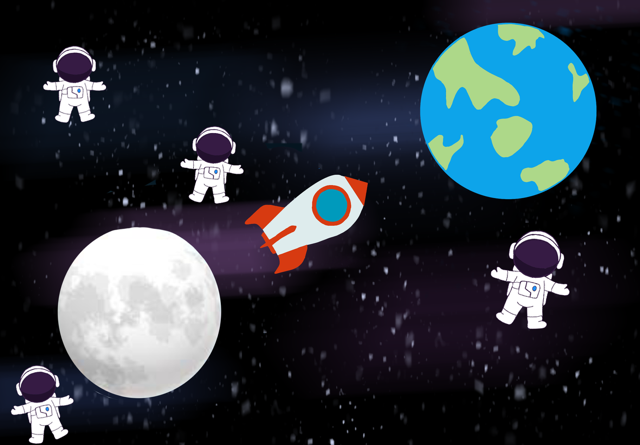
On April 1, 2026, NASA launched their 10-day lunar flyby mission. This mission made history as the first human journey beyond low Earth orbit since 1972, as well as being the furthest humans have ever traveled from Earth. This journey sent four astronauts, Reid Wiseman, Victor Glover, Christina Koch and Jeremy Hansen, on a space craft called Artemis II to test life support and navigation and human performance in space.
Wiseman, the Mission Commander, led the crew on this expedition. He was in charge of the other astronauts, made final decisions, supervised how the craft was operated and handled emergencies. He was a Navy test pilot, former chief of NASA’s astronaut office and spent 165 days in space in 2014 on the International Space Station (ISS).
Glover, the pilot of Artemis II, was responsible for operating and flying the spacecraft during the mission. He controlled and monitored the craft, assisted with adjusting the path, leaving Earth’s orbit and the return back to Earth. If Wiseman is not able to handle a certain task, Glover will take over. Glover was a former Navy fighter Pilot and is an experienced NASA astronaut as he is a naval aviator.
Koch, the mission specialist, helped the crew manage the expedition, ran experiments and collected data about human life on the moon. Koch made history as the first female to travel this far in space. Koch is an engineer who has been an astronaut for NASA since 2013. She spent nearly a full year in space in 2020 and completed multiple space walks outside the space station in 2019 to replace a failed battery charge discharge unit.
Hansen, another mission specialist, is set to maintain communication with Earth, helping with experiments regarding human health and navigation. He is the first ever Canadian astronaut to go on a lunar mission and is set to make history as the first non-American to go this far from Earth. Before becoming an astronaut, he was a fighter pilot in the Royal Canadian Air Force and was selected by the Canadian Space Agency to be an astronaut in 2009.
The Artemis II mission took place and followed a timeline of events. Day one was the launch of the craft, with the first hours being spent reaching space. The system was checked over by the crew ensuring the mission is running smoothly. On days two and three, the aircraft was still being observed and adjusted; the crew started to set way to the moon. Days four through six consisted of traveling to the moon. The crew was in deep space and ran experiments in space. On day seven, the main flyby, the spacecraft reached the moon. It flew among the far side and went 41 minutes without communication with the Earth. The crew observed the moon from views humans have not seen in decades. Days eight and nine were the return back to Earth, The spacecraft started to fly back to Earth using the moon’s gravity. The final day, 10, was the re-entry and landing in the Pacific Ocean off the coast of San Diego. The craft came back into the Earth’s atmosphere and splashed down into its landing.
The Artemis II represents a significant step in space exploration. This crew will take on the journey of going around the moon for the first time since 1972. This Journey will help secure future missions around the earth and test what human life could look like on the earth. This journey inspires future scientists and astronauts to take more of a deep dive into time ahead in space.